Childhood Interrupted – Immersive Art Installation
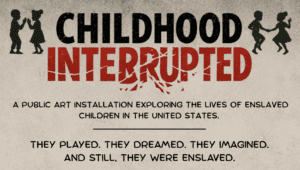
Childhood Interrupted – a powerful pop-up art installation created by (Un)Known Project co-founder, poet, author, and artist Hannah Drake – honors the resilience, imagination, and humanity of enslaved children. Through moments of play, learning, wonder, and possibility, the installation asks us to remember not only what was taken, but also what endured, and to imagine what these children might have become had they been allowed to simply be children.
Childhood Interrupted will be on display at Farmington Historic Plantation from June 6 – 18, 2026, and will be featured at multiple plantations throughout Louisville in the coming months.
Artist Statement
Childhood Interrupted is an immersive art installation that invites visitors to consider a history that is often overlooked: the lives of children born into enslavement.
The black silhouettes throughout the landscape depict children reading, dreaming, fishing, dancing, jumping rope, playing games, imagining, and learning. They represent moments of childhood that are universal across time and place. Yet these children lived within a system that denied them freedom and treated them as property.
The installation asks us to hold two truths at once.
1. These children experienced joy. They laughed, played, formed friendships, nurtured dreams, and found moments of wonder.
2. These children also endured profound injustice. They labored, faced the threat of family separation, were denied educational opportunities, and lived under the constant reality of bondage.
The silhouettes are intentionally black, appearing almost as shadows across the landscape. They symbolize both presence and absence. They remind us of the countless children whose names were never recorded, whose stories were never fully told, and whose futures were forever altered by enslavement.
As visitors move through the installation, they encounter a tension between play and restraint, possibility and limitation, innocence and oppression. Rather than focusing solely on suffering, Childhood Interrupted centers the humanity of these children and invites us to imagine not only what they endured, but who they might have become.
The installation also asks us to look beyond the past. While reflecting on the interrupted childhoods of yesterday, we are challenged to consider the children among us today. Are we creating a world where all children can learn, imagine, wonder, and grow? Or are there still forces that interrupt childhood and limit possibilities?
Childhood Interrupted is an invitation to remember, to reflect, and to bear witness. It honors the resilience, imagination, and humanity of children whose stories deserve to be seen, heard, and remembered.
-Hannah Drake
Childhood Interrupted Reflection Questions
As You Walk Through the Installation
- Which silhouette drew your attention first? Why?
- What emotions did you experience as you moved through the installation?
- How does seeing children at play change your understanding of the history of enslavement?
- Why do you think the silhouettes are black, almost like shadows?
Holding Two Truths
The children in this installation laughed, dreamed, imagined, learned, and played. They also lived under a system that denied them freedom.
- Why is it important to remember both truths?
- How might focusing only on suffering erase part of these children’s humanity?
- How might focusing only on resilience hide the injustice they endured?
- What does it mean to hold both joy and pain in the same story?
Family Conversation
- What games or activities did you enjoy as a child?
- Who helped nurture your imagination and dreams?
- What opportunities were available to you that these children did not have?
Connecting Past and Present
- What does every child need to thrive?
- Are there children today whose childhoods are being interrupted by poverty, racism, violence, discrimination, war, or lack of opportunity?
- How can we create communities where all children are free to learn, imagine, wonder, and grow?
Teachers and Educators
Elementary School (Grades K-5)
- What game or activity in the installation would you have liked to play with the children? Why?
- What do all children need to learn, grow, and feel safe?
- What is one thing you learned about the children in this installation?
Middle School (Grades 6-8)
- What surprised you most about the lives of the children represented in this installation?
- Why is it important to remember that enslaved children played, dreamed, and imagined just like children today?
- What might these children have become if they had been allowed to simply be children?
High School (Grades 9-12)
- How does Childhood Interrupted challenge or expand your understanding of the history of enslavement?
- The installation asks visitors to hold two truths at once: that enslaved children experienced joy while also living under oppression. Why is it important to remember both?
- Are there children today whose childhoods are interrupted by injustice, discrimination, poverty, violence, or lack of opportunity? What responsibility do communities have to address these challenges?