Oxmoor Farm
Oxmoor Farm
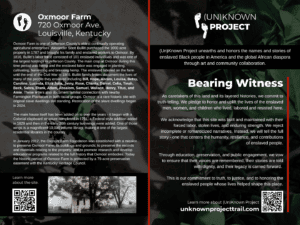
Oxmoor Farm is one of Jefferson County’s oldest continually operating agricultural enterprises. Alexander Scott Bullitt purchased the 1000 acre property in 1787 and brought his family and enslaved workers to Oxmoor. By 1816, Bullitt’s labor force consisted of 101 enslaved individuals and was one of the largest holdings in Jefferson County. The main crop at Oxmoor during this time period was hemp and the enslaved labor was engaged in planting, cultivating, harvesting and breaking hemp. The enslaved labored on the farm until the end of the Civil War in 1865. Bullitt family letters document the lives of many of the people they enslaved including Bill, Hope, Abram, Louisa, Betsy, Caroline, Lucinda, Eliza Julia, Jinny, Rose, Charity, Daniel, Celia, Tinah, Beck, Sabra, Frank, Adam, Absalom, Samuel, Wallace, Henry, Titus, and Amie. These letters also document familial connections with nearby Farmington Plantation in both racial groups. Oxmoor is a rare historic site with original slave dwellings still standing. Restoration of the slave dwellings began in 2024.
The main house itself has been added on to over the years – it began with a Colonial clapboard structure completed in 1791, a Federal style addition added in 1829 and then in the early 20th century two wings were added. One of those wings is a magnificent 10,000 volume library, making it one of the largest residential libraries in the country.
In January 2017, the Oxmoor Farm Foundation was established with a mission to preserve Oxmoor Farm, its buildings and grounds; to preserve the records and materials relating to the property; and to promote research and develop educational programs related to the full history that Oxmoor embodies. Today the historic portion of Oxmoor Farm is protected by a 79-acre preservation easement with the Kentucky Heritage Council.